Beyond License Plates: How Modern Surveillance Systems Correlate Vehicles, Smartphones, and IoT Devices
Explore how modern surveillance concepts combine license plate recognition, Bluetooth signals, smartphones, smartwatches, and IoT devices to analyze movement patterns, build device associations, and create multi-signal correlation systems.
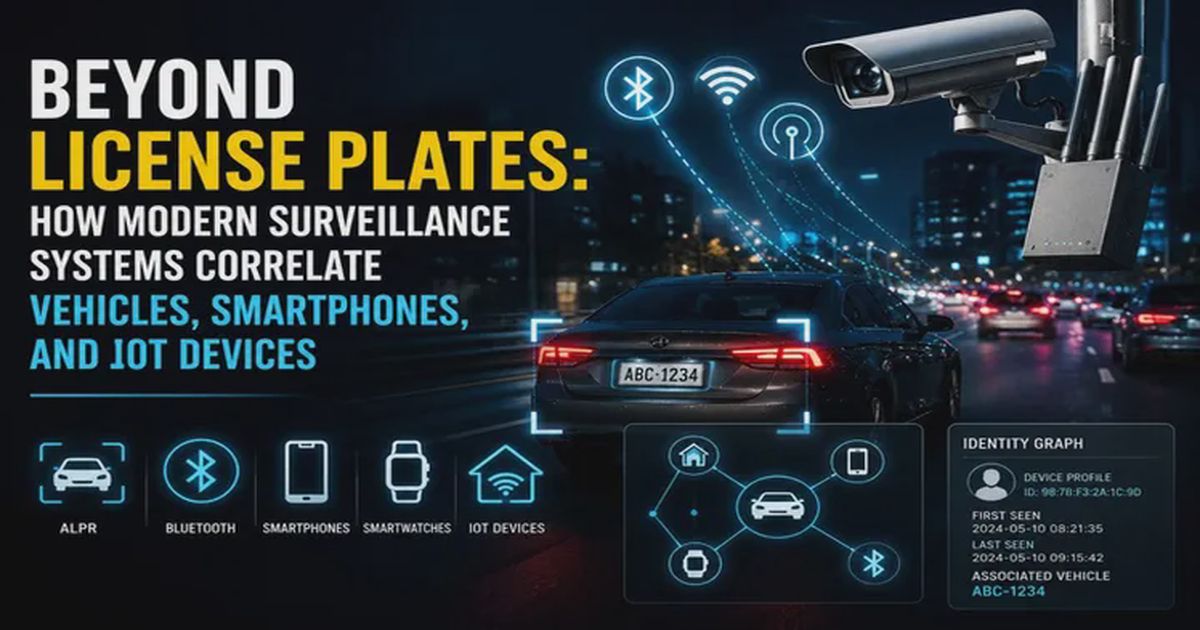
Imagine driving down a highway at night. As you pass beneath a toll gantry, a high-speed infrared camera snaps a photo of your license plate, matching it against a database in seconds. But from a technological standpoint, the tracking does not have to stop at your bumper. Theoretically, a series of passive antennas mounted on that same gantry could intercept the Bluetooth advertisements from your smartwatch, the Wi-Fi probe requests from the phone in your glovebox, and the unique wireless signatures from your vehicle’s built-in infotainment system.
In this scenario, a correlation engine could potentially link these digital signatures to a physical vehicle, illustrating how a digital profile might be associated with a physical journey over time.
For decades, Automatic License Plate Recognition (ALPR) systems have been the go-to tool for vehicle identification. Cameras mounted on highways, toll booths, parking lots, and police cars capture license plate numbers and match them against databases in milliseconds.
But the technology landscape has shifted.
Today’s vehicles travel alongside a massive ecosystem of connected devices. Smartphones broadcast wireless signals, smartwatches communicate with mobile devices, and Bluetooth peripherals constantly talk to nearby receivers.
As a result, discussions around modern surveillance are no longer limited to identifying a vehicle in isolation. Instead, next-generation concept architectures explore correlating multiple signals to build a richer model of movement patterns across both physical and digital environments.
Rather than asking, “Which vehicle passed through this location?” modern design concepts explore asking, “Which devices consistently travel in proximity to this vehicle?”
Let’s take a look under the hood of these multi-signal systems, explore how device correlation works, and examine the technical and privacy challenges involved in their design.
The Foundation: Automatic License Plate Recognition (ALPR)
Automatic License Plate Recognition (ALPR) is a computer vision technology that automatically detects and reads vehicle license plates from images or video streams [1].
A typical ALPR workflow follows four major steps:
- Image Capture: High-resolution cameras—often equipped with infrared sensors, night vision, and motion compensation—continuously monitor roads, toll stations, and parking facilities to capture clear images regardless of weather or vehicle speed.
- License Plate Detection: Computer vision algorithms identify the exact location of the license plate within the captured frame. Modern systems use deep learning models trained on millions of vehicle images to handle angled perspectives, damaged plates, or different regional plate formats.
- Optical Character Recognition (OCR): Once the plate is isolated, OCR software extracts individual characters and converts them into machine-readable text (e.g.,
WB24AB1234). - Database Matching: The extracted plate number is queried against databases containing vehicle registrations, stolen vehicle records, parking permits, or toll accounts. This query process is designed to happen within milliseconds in typical deployments.
Why License Plates Alone Aren’t Enough
While modern computer vision makes reading a clean plate easy, real-world roads are messy. Traditional ALPR systems run into physical and structural roadblocks every day:
- Temporary and Missing Plates: Paper dealer tags, temporary transit permits, or simply missing front plates frequently disrupt database tracking.
- Physical Obstruction: Rain, snow, road grime, or intentional physical damage can easily render a plate unreadable to a camera.
- The “Shared Car” Problem: A vehicle registered to a single owner might be driven by different family members, delivery drivers, or rideshare operators.
- Ownership Transitions: Fleet vehicles, rentals, and sold cars change hands constantly, making the plate a poor indicator of who is actually behind the wheel.
Because a license plate only identifies a piece of metal, engineers and security firms have shifted focus. They are looking beyond the bumper to capture signals that identify the occupants rather than just the car.
The Rise of Multi-Signal Surveillance
Modern vehicles rarely travel alone. In most situations, they are accompanied by numerous wireless devices:
- Smartphones and smartwatches
- Bluetooth earbuds and headphones
- Built-in vehicle infotainment systems
- Mobile Wi-Fi hotspots
- GPS trackers and IoT sensors
Each of these devices emits wireless signals that are theoretically detectable by passive receivers. Individually, these signals reveal very little. However, research suggests that when combined over time, they can create correlative patterns. This is where next-generation concepts transition from simple identification tools toward multi-signal correlation models.
Understanding Bluetooth-Based Device Detection
One of the most common signals used in modern correlation systems is Bluetooth. Specifically, Bluetooth Low Energy (BLE)—the low-power protocol built into everything from your fitness tracker to your wireless earbuds.
Unlike classic Bluetooth, which requires you to actively pair a device, BLE operates on passive broadcasts. To let other devices know they are nearby, BLE devices constantly transmit small packets of data called Advertisements.
Roadside receiver units do not need to connect to your phone to track you. They just listen.
  [Smartphone / Wearable]
            │
            ▼ (BLE Broadcasts: MAC, RSSI, TxPower)
  [Roadside Sensor Node]
            │
            ▼ (Event Metadata: Timestamp, Sensor ID, Device ID, RSSI)
     [Event Database]
When you pass a sensor, it passively logs the timestamp, the signal strength (RSSI) to estimate your distance, device metadata (like GATT service profiles), and the broadcast MAC address. It is entirely passive, silent, and works at scale.
The Wi-Fi Fingerprint: Probe Requests
Bluetooth is not the only RF technology broadcasting discoverable identifiers. Under certain configurations, smartphones search for familiar access points by broadcasting Probe Requests—small frames containing:
- The device’s current MAC address (which is often randomized by modern operating systems).
- Supported data rates and radio capabilities.
- In some configurations, a list of previously connected network names (SSIDs).
Because Wi-Fi signals can have a longer transmission range than BLE in certain environments, researchers and network security practitioners have demonstrated that appropriately configured monitoring systems can observe probe-request activity under specific conditions.
Device Correlation: The Real Innovation
Detecting a single Bluetooth signal is trivial. The real breakthrough in modern tracking is correlation.
If a sensor detects your car’s license plate and your phone’s wireless signature at the same time once, it is a coincidence. If it detects them together five times at different intersections over a month, it is a pattern.
Imagine a correlation system that observes:
Vehicle: WB24AB1234

Detected Devices:
- Smartphone A
- Smartwatch B
- Earbuds C
One observation alone means very little. However, suppose the system repeatedly sees the same vehicle and the same devices together over several months.
The dataset might begin to look like this:
| Observation | Vehicle | Smartphone |
|---|---|---|
| Day 1 | WB24AB1234 | Device A |
| Day 4 | WB24AB1234 | Device A |
| Day 10 | WB24AB1234 | Device A |
| Day 18 | WB24AB1234 | Device A |
| Day 30 | WB24AB1234 | Device A |
At some point, statistical confidence increases significantly. The system may infer that Device A frequently travels with Vehicle WB24AB1234.
The Mathematics of Correlation: Measuring Observation Similarity
Detecting a device near a vehicle once does not provide enough information to establish a meaningful relationship. In real-world environments, smartphones, smartwatches, and other wireless devices constantly move through shared spaces, creating numerous coincidental observations.
To determine whether a device is repeatedly observed alongside a vehicle, correlation systems can analyze patterns of spatial-temporal co-occurrence.
One possible way to measure similarity between two sets of observations is the Jaccard Similarity Index, a widely used metric in data science, machine learning, clustering, and recommendation systems.
In this simplified example:
- Let V represent the set of observations associated with a vehicle.
- Let D represent the set of observations associated with a device.
The Jaccard Similarity Index is defined as:
$$
J(V,D) = \frac{|V \cap D|}{|V \cup D|}
$$
Where:
- V ∩ D (Intersection) represents observations where both the vehicle and device were detected within the same spatial and temporal boundaries (for example, within a few meters and a few seconds of each other).
- V ∪ D (Union) represents the total number of unique observations associated with either the vehicle or the device.
For example, imagine a vehicle is detected 100 times over a month and a smartphone is detected 80 times. If 75 of those observations occur together, the overlap between the two observation sets would be relatively high.
In this simplified scenario, a higher Jaccard score would indicate a stronger overlap between the vehicle and device observation histories, while a lower score would suggest little meaningful overlap.
It is important to note that real-world correlation systems often rely on multiple signals, statistical models, confidence scoring methods, and machine learning techniques. The Jaccard Similarity Index is presented here only as a simple conceptual example of how observation similarity can be measured.
Building an Identity Graph
Graph-based architectures are widely used in fields such as fraud detection, recommendation systems, cybersecurity, and network analysis. Similar modeling approaches can also be applied to surveillance and correlation systems to represent relationships between vehicles, devices, locations, and events. Rather than storing isolated events as independent records, graph-based models represent relationships between entities such as vehicles, devices, locations, and observations.
                    ┌─────────────────┐
                    │ Vehicle Entity  │
                    │ WB24AB1234      │
                    └────────┬────────┘
                             │
          ┌──────────────────┼──────────────────┐
          │                  │                  │
          ▼                  ▼                  ▼
   Smartphone A      Smartwatch B       Earbuds C
   Confidence 0.98   Confidence 0.85    Confidence 0.21
          │                  │                  │
          └──────────┬───────┴──────────┬───────┘
                     ▼                  ▼
              Toll Gantry #4     Parking Lot B
In a graph database, observations are modeled to adjust the relationship weights between nodes. Over time, such models aim to build a structured representation of movement patterns.
This architecture is commonly referred to as an Identity Graph. While identity graphs are an established concept in advertising, fraud detection, and cybersecurity, surveillance system research and design literature increasingly discuss adopting similar concepts for physical tracking.
The Role of AI and Machine Learning
Large-scale correlation processes would generate significant amounts of data. For instance, a large-scale deployment could theoretically collect:
- Millions of vehicle observations
- Millions of device detections
- Billions of event records annually
Traditional rule-based systems can struggle to process and resolve data at this scale. Machine learning is often proposed to assist in:
- Pattern Recognition: Identifying recurring spatial-temporal associations.
- Confidence Scoring: Estimating the statistical likelihood that a device travels with a particular vehicle.
- Anomaly Detection: Detecting unusual or divergent behavior patterns.
- Entity Resolution: Evaluating whether multiple transient identifiers likely represent the same physical device.
As machine learning models evolve, the precision of these estimation tasks can increase.
Edge Computing and Real-Time Processing
Many modern surveillance system designs leverage edge computing concepts. Instead of sending every raw observation to a central server, roadside systems can perform initial processing locally.
Benefits include:
- Reduced bandwidth usage
- Lower latency
- Faster response times
- Lower cloud storage costs
A typical architecture may look like:
  [High-Speed Camera] ──> (Video Feed) ──┐
                                         ▼
                                ┌────────────────────────────────┐
                                │       Edge Compute Node        │
                                │ ┌────────────────────────────┐ │
  [RF Antennas] ──────> (RF) ───> │ │  Local Plate OCR           │ │
                                │ └──────────────┬─────────────┘ │
                                │                ▼               │
                                │ ┌────────────────────────────┐ │
                                │ │  Signal Parsing/Filtering  │ │
                                │ └──────────────┬─────────────┘ │
                                │                ▼               │
                                │ ┌────────────────────────────┐ │
                                │ │  Spatial-Temporal Joiner   │ │
                                │ └──────────────┬─────────────┘ │
                                └────────────────┼───────────────┘
                                                 ▼
                                     (Correlated Event Packets)
                                                 │
                                                 ▼
                                     [(Central Identity DB)]
This architecture allows large-scale deployments to remain efficient and scalable.
Engineering Challenges
Despite impressive capabilities, these systems face significant technical challenges.
MAC Address Randomization and Fingerprinting Research
Modern smartphones running iOS (14+) and Android (10+) implement MAC Address Randomization. When a phone scans for networks or broadcasts BLE beacons without an active connection, it typically uses a temporary, randomized MAC address that changes periodically to protect user privacy [2].
Because MAC address randomization makes long-term device identification more difficult, academic research and commercial security vendors have explored several correlation and device characterization techniques. However, the practical effectiveness of these methods varies significantly depending on environmental conditions, hardware quality, and deployment scale.
- RF Fingerprinting: Researchers have explored whether subtle hardware-level characteristics—such as carrier frequency offset, phase noise, or transient signal behavior—can be used to distinguish one radio transmitter from another [4]. While laboratory studies have demonstrated promising results, real-world deployments face challenges related to signal interference, environmental variability, and device diversity. As a result, RF fingerprinting remains an active area of research rather than a universally proven tracking method.
- GATT Service Profiles: Some BLE-enabled devices may expose consistent combinations of service UUIDs, manufacturer data, transmission power settings, or advertising structures. In certain situations, these characteristics can contribute to device classification or correlation, although they are generally insufficient for reliable identification on their own.
- Temporal Linkage: Correlation models can analyze continuous movement patterns across time and location. If multiple identifiers appear sequentially along the same trajectory and within consistent spatial boundaries, a system may infer that they belong to the same device. Such inferences are probabilistic and depend heavily on observation quality and contextual data.
It is important to note that modern privacy protections implemented in iOS and Android are specifically designed to reduce the effectiveness of persistent device tracking. Consequently, any correlation approach must contend with varying levels of uncertainty and potential false positives.
Signal Noise
Urban environments contain thousands of devices. Many detected devices may have no relationship to nearby vehicles. Distinguishing meaningful associations from random proximity is extremely difficult.
False Positives
A parking lot may contain hundreds of vehicles and thousands of devices. Incorrect correlations can occur if the system overestimates relationships.
Data Storage
Even a medium-sized city can generate massive amounts of data daily. Storage infrastructure must support:
- High write throughput
- Long-term retention
- Fast search capabilities
- Real-time analytics
This often requires distributed databases and streaming data architectures.
Privacy and Regulatory Considerations
From a technical perspective, multi-signal surveillance systems are fascinating. However, they also raise important questions.
Critics argue that combining multiple identifiers can create detailed movement profiles over time. Supporters argue that such systems improve vehicle recovery, public safety, traffic investigations, and criminal investigations.
The challenge lies in balancing technological capabilities with reasonable privacy expectations.
The Legal Landscape: GDPR and US Case Law
- GDPR (Europe): European privacy regulators have generally treated license plate numbers and certain device identifiers as personal data when they can reasonably be linked to an identifiable individual [3]. As a result, organizations processing such information may need to establish a lawful basis for collection, storage, and analysis under applicable privacy regulations.
- The Fourth Amendment and Carpenter v. United States: In the US, the Supreme Court ruled in Carpenter v. United States (2018) that the government generally requires a warrant to access historical cell-site location information (CSLI) due to expectations of privacy in physical movements [5]. Legal scholars have debated whether aggregating multiple passive signals (such as ALPR, BLE, and Wi-Fi data) could be interpreted under similar standards, potentially raising questions about warrant requirements for database searches of historical correlation records.
Key questions include:
- How long should data be stored?
- Who can access the information?
- How accurate must correlations be?
- What oversight mechanisms should exist?
These debates will likely continue as surveillance technology becomes more sophisticated.
The Future of Surveillance Infrastructure
The future of surveillance is unlikely to rely on a single identifier. Instead, modern systems will increasingly combine computer vision, license plate recognition, Bluetooth analysis, IoT device detection, AI-based correlation, real-time analytics, and edge computing.
Rather than simply recognizing a vehicle, future platforms may focus on understanding relationships between devices, locations, and movement patterns. This represents a significant shift from traditional surveillance toward what can best be described as multi-signal intelligence systems.
Frequently Asked Questions (FAQ)
1. Can turning off Bluetooth and Wi-Fi on a phone prevent this type of tracking?
Turning off Bluetooth and Wi-Fi through system settings generally prevents most BLE advertisements and Wi-Fi probe requests from being transmitted. However, behavior can vary depending on the device, operating system, and enabled services.
2. How can correlation models distinguish a driver’s phone from a passenger’s or pedestrian’s phone?
Models typically rely on statistical analysis over multiple observations. A passing pedestrian’s device is only transiently co-located with the vehicle. A passenger’s device might show a correlation score over shared journeys, but its correlation strength will differ from the primary driver’s device if the passenger does not accompany the vehicle on all trips.
3. Are these systems legally compliant for private entities (like malls or parking structures) to operate?
The legality of operating such systems varies significantly by jurisdiction and the specific context of use. In some regions, private entities utilize similarity-matching technologies for logistics or parking management, subject to disclosures, opt-out mechanisms, and data-retention limits under laws like California’s CCPA/CPRA or Europe’s GDPR. Because privacy regulations are evolving, operators typically seek local legal counsel to ensure compliance.
4. Can correlation databases be queried retroactively?
If a database stores historical logs of license plates and wireless signal events, it is technically possible to query the history of a specific identifier to analyze past co-location patterns. However, such queries are subject to data retention policies, technical access controls, and applicable legal restrictions.
Final Thoughts
The shift from simple license plate reading to multi-signal correlation is a major step in surveillance design. It blurs the line between the physical vehicle and the digital footprint. As our cars, phones, and wearables become more tightly integrated, the signals they emit will continue to paint a detailed picture of our daily routines.
For developers, engineers, and policymakers alike, the challenge is no longer just how to build these correlation systems—but deciding where the boundaries of physical privacy should lie in an increasingly broadcast-heavy world.
References & Further Reading
- [1] Electronic Frontier Foundation (EFF). (2020). Street-Level Surveillance: Automated License Plate Readers (ALPRs). Available at eff.org.
- [2] Martin, J., Mayberry, T., Donahue, C., Foppe, K., Brown, L., Riggins, C., Rye, E. C., & Brown, D. (2017). “A Study of MAC Address Randomization in Mobile Devices and When it Fails.” Proceedings on Privacy Enhancing Technologies (PoPETs), 2017(4), 86-104.
- [3] European Data Protection Board (EDPB). (2021). Guidelines 01/2020 on processing personal data in the context of connected vehicles and mobility-related applications (Version 2.0).
- [4] Brik, V., Banerjee, S., Gruteser, M., & Oh, S. (2008). “Wireless Device Identification with Radiometric Signatures.” Proceedings of the 14th ACM International Conference on Mobile Computing and Networking (MobiCom).
- [5] Carpenter v. United States, 138 S. Ct. 2206 (2018). Information regarding Fourth Amendment limits on historical location database searches.
Subhodip Ghosh
Engineering, systems programming, and curated technology insights.