How Humans Traveled 5000 Years Ago Without Google Maps — And What We Lost Today
Explore how humans traveled across civilizations 5000 years ago without GPS, and how modern navigation changed freedom, technology, and human connection.
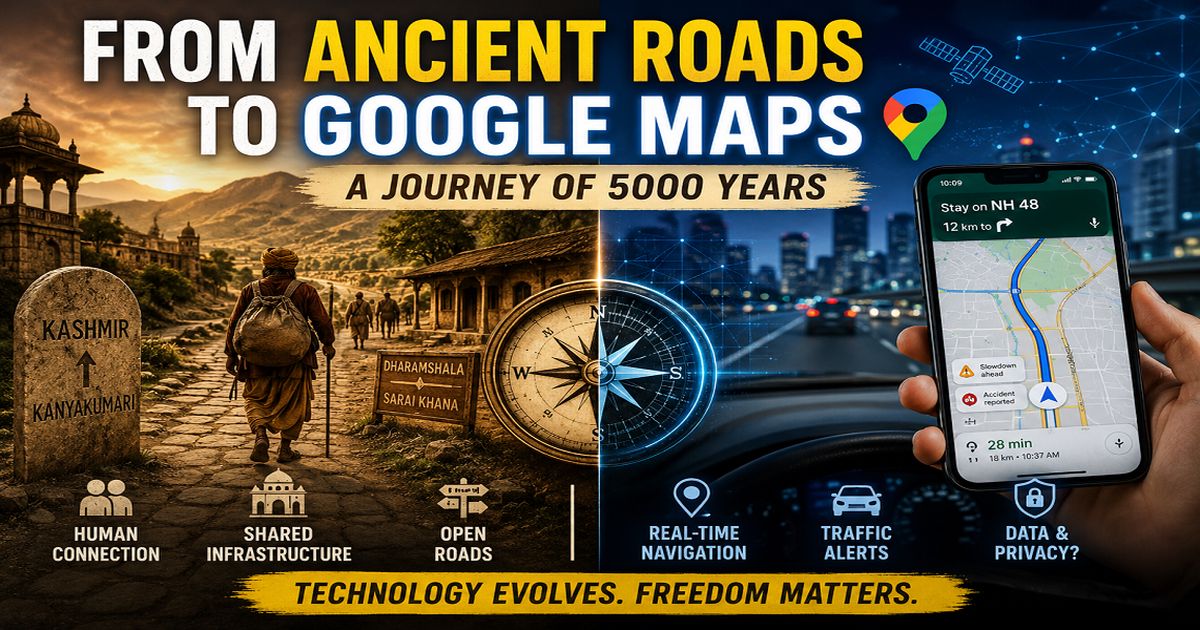
Today, most of us cannot imagine traveling without a smartphone. Before leaving home, we open Google Maps, check traffic, calculate travel time, and follow the small blue dot until we reach our destination.
Modern navigation feels magical.
Your phone can:
- Detect traffic jams
- Suggest alternate routes
- Warn about accidents
- Estimate arrival times
- Even identify sudden braking ahead on the road
It is fast, intelligent, and deeply connected to our daily lives.
But this raises an interesting question:
Did humans really become better at navigation, or did we simply replace human knowledge with digital dependency?
To understand this, we need to look back — not 50 years, but thousands of years.
Traveling 5000 Years Ago Was More Advanced Than We Think
Many people assume ancient civilizations were disconnected and isolated. In reality, humans have been traveling across massive distances for thousands of years.
India alone had some of the oldest trade and travel networks in the world.
Travelers moved between:
- Kashmir and Kanyakumari
- Bengal and Afghanistan
- India and Southeast Asia
- Ancient Silk Route regions
And surprisingly, they did this without:
- GPS
- Satellites
- Smartphones
- Internet
- Digital maps
So how did they navigate?
The Ancient System of Navigation
Ancient travelers depended on:
- Road signs
- Rivers
- Stars
- Mountains
- Local communities
- Oral knowledge
Road infrastructure already existed centuries ago.
One famous example is the road connecting Kolkata and Jessore. Historians believe parts of this route are more than 5000 years old. These were not “new” roads created by modern governments. They were part of old travel systems used for trade, migration, and cultural exchange.
Travelers also used:
- Dharamshalas for resting
- Sarai Khanas for meals and shelter
- Community-based hospitality systems
Travel was deeply connected with society itself.
People trusted humans more than algorithms.
The Rise of Digital Navigation
Everything changed with smartphones.
Modern navigation systems became powerful because they combined:
- GPS satellites
- Mobile internet
- Real-time traffic data
- Cloud computing
- Artificial intelligence
Today, Google Maps dominates navigation because it is connected to a massive ecosystem.
Especially through:
- Android smartphones
- User-generated traffic data
- Real-time location tracking
- Business integrations
The system works so well because billions of devices constantly feed information back into the network.
This convenience transformed modern travel.
But convenience also created dependence.
The “Walled Garden” Problem
Modern technology is incredibly useful, but much of it is controlled by closed ecosystems.
This is often called a walled garden.
In simple words:
- You use the technology
- But you do not fully control it
Examples include:
- Locked operating systems
- Proprietary software
- Device restrictions
- Closed app ecosystems
- Data collection systems
Even basic hardware often depends on company-controlled software.
For example:
- Some printers become difficult to use without official drivers
- Games may only run on certain platforms
- Apps collect large amounts of user data automatically
The concern is not just technology itself.
The concern is:
Who controls the digital roads we now depend on?
Ancient Roads Were More Open Than Modern Digital Platforms
This comparison is one of the most interesting parts of the discussion.
Ancient travel systems were surprisingly open:
- Roads belonged to society
- Knowledge was shared freely
- Travelers depended on communities
- Infrastructure was decentralized
Modern digital systems are often the opposite:
- Platforms are owned by corporations
- Data is centralized
- Users are tracked
- Services are controlled by private ecosystems
In the physical world, humans once traveled freely across continents.
But in the digital world, we increasingly travel inside systems owned by a few companies.
The Forgotten Era of Navigation Software
Before smartphones became dominant, navigation software looked very different.
One interesting example was Yahoo! Go.
What Was Yahoo Go?
Yahoo Go was a mobile application created during the early smartphone era.
It offered:
- Maps
- Navigation
- Email access
- News
- Weather
- Search features
At the time, mobile internet was still developing, and apps like Yahoo Go tried to create an all-in-one mobile experience.
Although it never reached the dominance of Google Maps, it represented an earlier internet era where many companies experimented with digital navigation and mobile ecosystems.
Eventually, Android and Google’s ecosystem became dominant, and many alternatives slowly disappeared.
This shows how quickly technology ecosystems can change.
Open Source and Digital Freedom
As technology became more centralized, many developers and activists started supporting Free and Open Source Software (FOSS).
The idea is simple:
Users should have the freedom to:
- Study software
- Modify software
- Share software
- Control their own systems
One of the most important figures in this movement is Richard Stallman.
He spent decades promoting the idea of software freedom and warning about excessive corporate control over digital life.
Today, many technologies are powered by open-source systems:
- Linux servers
- Web infrastructure
- Android’s Linux kernel
- Programming tools
- Cloud platforms
Even modern gaming devices like the Steam Deck helped popularize Linux-based gaming systems for mainstream users.
Convenience vs Freedom
This is not a simple “technology bad” argument.
Modern navigation genuinely improves life:
- Faster travel
- Better logistics
- Emergency response
- Business efficiency
- Public transportation planning
But the discussion becomes important when convenience slowly replaces independence.
When people stop understanding:
- how systems work
- how data is collected
- who owns infrastructure
- how digital platforms shape behavior
they become dependent without realizing it.
What Future Are We Building?
The real question is not whether Google Maps is useful.
Of course it is.
The deeper question is:
Are we building a future where technology empowers humans, or controls them?
Ancient travelers built civilizations through open roads, cultural exchange, and shared knowledge.
Modern society now builds digital highways instead of physical ones.
The challenge is making sure these digital roads remain:
- open
- fair
- accessible
- privacy-respecting
- community-driven
Because technology should help humans remain free — not quietly turn them into products inside closed ecosystems.
Data Became the New Fuel of Navigation
Modern navigation apps are not powered only by maps.
They are powered by data.
Every second, smartphones collect:
- location information
- movement speed
- search history
- travel habits
- nearby businesses visited
- traffic behavior
This data helps improve navigation systems.
But it also creates one of the largest surveillance networks in human history.
When billions of people continuously share location data, companies gain extraordinary power to understand human behavior.
The map is no longer just showing roads.
The map is studying people.
The Psychological Dependency on Smart Navigation
Modern humans increasingly trust algorithms more than their own judgment.
Examples:
- People driving into rivers because GPS said “turn”
- Tourists ignoring local advice
- Drivers blindly following navigation without awareness
Technology is useful, but overdependence creates passive thinking.
Ancient travelers stayed alert because survival depended on awareness.
Modern travelers often follow instructions automatically.
This changes not only travel habits —
but also how humans think and make decisions.
Navigation Became a Business
Ancient roads were mostly built for:
- trade
- communication
- pilgrimage
- cultural exchange
Modern digital navigation is also connected with:
- advertising
- user tracking
- local business promotion
- data monetization
When you search for:
- restaurants
- hotels
- fuel stations
- shops
the platform may influence what you see first.
This means navigation is no longer fully neutral.
The road itself became part of the digital economy.
Final Thoughts
Navigation has evolved from stars and road signs to satellites and artificial intelligence.
But the human desire behind navigation has never changed:
- exploration
- connection
- discovery
- freedom
Five thousand years ago, travelers crossed continents using shared human knowledge.
Today, we travel with algorithms in our pockets.
The tools became smarter.
The question is whether we also became wiser.
And perhaps the future of technology is not just about finding the fastest route —
but about building digital systems that respect human freedom as much as human convenience.
Want to deploy apps, clusters, or Customize hosting services?
👉 Explore our services at siliconpin.com and start building your own edge infrastructure today.
Subhodip Ghosh
Engineering, systems programming, and curated technology insights.