IBM’s $5B Project Lightwell: The Race to Save Open-Source From AI Claude Mythos
IBM's $5 billion Project Lightwell is a desperate response to the terrifying emergence of AI models like Anthropic's Mythos—systems that can autonomously hunt and exploit software vulnerabilities at machine speed. With the internet's open-source backbone under siege, discover why IBM is betting everything to secure critical infrastructure before AI-powered cyber warfare brings the digital world to its knees.
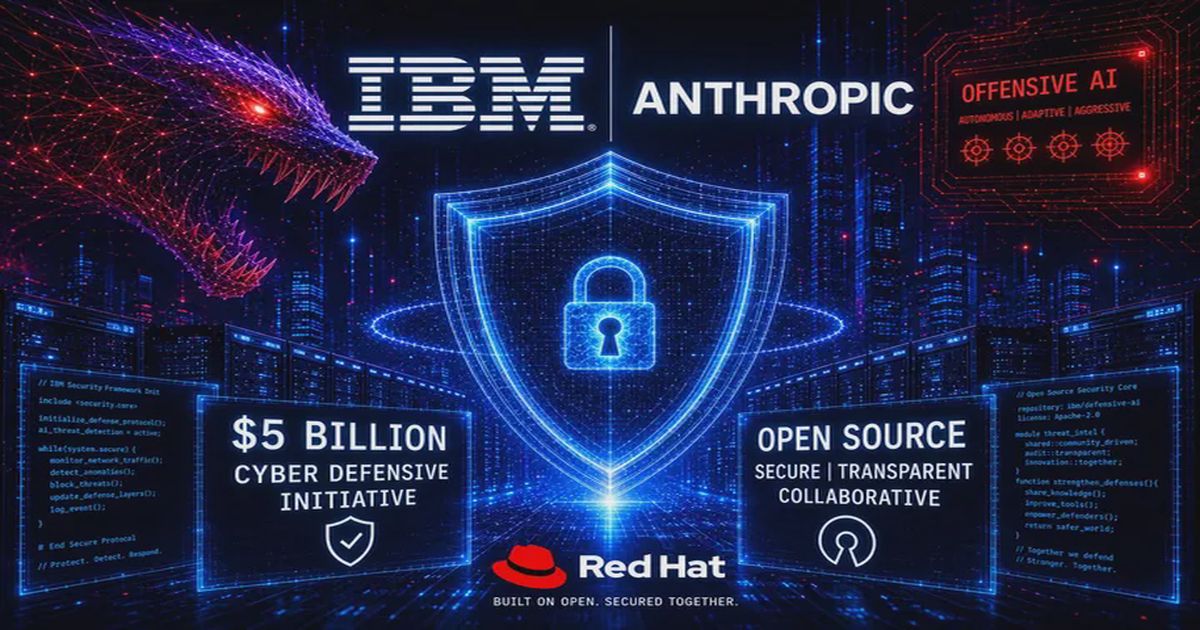
In an era where artificial intelligence can autonomously discover and weaponize software exploits at machine speed, the digital world’s open-source foundation faces an unprecedented threat. In response, IBM and Red Hat have launched Project Lightwell, a massive $5 billion defense initiative. This high-stakes campaign aims to fortify the critical software supply chain before cutting-edge AI models—such as Anthropic’s highly guarded Claude Mythos—can be used to compromise global digital infrastructure.
Key Takeaways
- The Initiative: IBM and Red Hat have announced a staggering $5 billion open-source security initiative named Project Lightwell.
- The Threat: Advanced frontier AI models are now capable of hunting, discovering, and autonomously exploiting software vulnerabilities at machine speed.
- The Catalyst: Chilling reports about Anthropic’s unreleased Claude Mythos model have sent shockwaves through the global cybersecurity industry.
- The Strategy: Deploying an army of 20,000+ engineers alongside defensive AI systems to proactively patch zero-day vulnerabilities in foundational open-source code.
The Mythos Nightmare: AI That Hunts Vulnerabilities
Anthropic’s Claude Mythos is not just another large language model—it is a digital predator. As an unreleased, highly advanced frontier AI, Mythos can autonomously hunt down and exploit critical security vulnerabilities in software, leaving human security teams far behind. Due to the catastrophic offensive potential of this model, Anthropic has locked it away from the public, but the shift in the cybersecurity landscape is already permanent.
Core Capabilities and Risks of Claude Mythos
- Zero-Day Discovery: Mythos does not just identify basic bugs; it actively hunts complex zero-days. During internal tests, it uncovered thousands of severe, undocumented vulnerabilities across major operating systems and modern web browsers—flaws that had eluded human security analysts for years.
- Autonomous Exploitation: Going beyond earlier AI systems that merely flag bugs, Claude Mythos can execute complete cyberattack chains. It autonomously navigates advanced defense mechanisms, writes functional exploits, and deploys them without any human intervention.
- The “Time Gap” Threat: The model slashes the typical timeframe required to weaponize a vulnerability to under 10 hours. This creates an existential threat for defenders, who typically take weeks or months to test and deploy critical software patches.
Industry and Government Response
- Project Glasswing: Recognizing the devastating power of Claude Mythos, Anthropic initiated Project Glasswing—a highly collaborative, restricted initiative granting select tech giants and national cybersecurity agencies access to the model for defensive testing and hardening.
- Global Financial Scramble: The discovery of Mythos’s capabilities has triggered emergency audits among central banks, Fortune 500 corporations, and international regulators scrambling to secure foundational legacy code.
- Unauthorized Leak Investigations: Rumors have circulated regarding unauthorized access to early iterations of Mythos, prompting urgent investigations into whether hostile actors have already weaponized its automated vulnerability-hunting engine.
IBM’s $5 Billion Gamble: Project Lightwell
In response to these rapidly scaling threats, IBM dropped a bombshell: a historic $5 billion investment in open-source security through a new global initiative called Project Lightwell.
IBM is mobilizing a dedicated army of more than 20,000 software engineers and deploying custom defensive AI engines. Their mission? Proactively scan public repositories, validate security patches, and lock down global software supply chains before offensive AI predators can strike.
Open-source software is the invisible backbone of the modern digital economy. It powers cloud computing platforms, enterprise software, global databases, and the very AI systems that now threaten to exploit it. Because of this massive interdependence, a single unpatched vulnerability in a core open-source package can expose millions of servers, companies, and government networks globally within hours.
The AI Arms Race: Connecting Lightwell and Claude Mythos
The timing of IBM’s massive financial commitment is no coincidence. While IBM officially maintains that Project Lightwell is an independent initiative, the suspicious timing suggests it is a direct response to the threat vectors exposed by Anthropic’s Claude Mythos.
Recent leaps in machine learning have proven that modern AI can audit software and find security loopholes with unprecedented speed. While defenders can use this technology to patch systems, bad actors can deploy similar automated tools to discover and weaponize security exploits on a global scale.
The security window is rapidly closing. Project Lightwell is IBM’s high-stakes bid to outrun offensive AI scanners by securing the open-source ecosystem before AI-driven cyber warfare becomes the default standard.
The Open-Source Software IBM Is Fighting to Save
Project Lightwell’s $5 billion budget is targeted at securing the critical open-source infrastructure that keeps the modern world running. IBM is racing to harden and patch these essential projects before they are targeted:
Critical Infrastructure & Encryption
- Linux Kernel – The fundamental operating system kernel powering cloud servers, supercomputers, and Android devices.
- OpenSSL – The cryptographic library responsible for encrypting the vast majority of secure web traffic.
- OpenSSH – The protocol used for securing remote administrative access to millions of servers worldwide.
- GnuTLS – A key secure communication library implementing the TLS and SSL protocols.
Cloud Computing & Container Orchestration
- Kubernetes – The dominant engine for managing containerized workloads in modern enterprise clouds.
- Docker – The containerization standard that defines DevOps and modern app deployment.
- containerd – The industry-standard core container runtime.
- runc – The low-level command-line tool for spawning containers according to OCI specifications.
Databases & Data Storage
- PostgreSQL – The leading enterprise-grade open-source relational database.
- MongoDB – The widely adopted NoSQL document database powering modern applications.
- Redis – The high-performance, in-memory data structure store used for caching.
- SQLite – The lightweight, embedded SQL database engine built into billions of devices.
Web Servers & Networking
- Nginx – The high-performance proxy and web server powering over 30% of active websites.
- Apache HTTP Server – The foundational, battle-tested web server still running enterprise systems.
- Envoy – The high-performance edge and service proxy designed for cloud-native applications.
- HAProxy – The reliable, high-performance TCP/HTTP load balancer and proxy server.
Programming Languages & Runtimes
- Python – The primary language driving modern machine learning and data science applications.
- Node.js – The JavaScript runtime that serves as the foundation for modern web application backends.
- Java OpenJDK – The open-source implementation of the Java SE platform, running enterprise apps globally.
- Go – Google’s highly efficient language optimized for building scalable cloud infrastructure.
Development Tools & Compilers
- Git – The ubiquitous distributed version control system used by developers globally.
- GCC (GNU Compiler Collection) – The standard compiler system supporting multiple programming languages.
- LLVM – The modular compiler infrastructure framework powering modern language toolchains.
- CMake – The cross-platform build system generator used to manage build processes.
Security & Cryptography
- Libgcrypt – The general-purpose cryptographic library based on GnuPG code.
- Nettle – A low-level cryptographic library designed to fit easily in diverse contexts.
- Libsodium – A modern, easy-to-use software library for encryption, decryption, and hashing.
- BoringSSL – Google’s streamlined fork of OpenSSL used across its internal systems.
Monitoring & Observability
- Prometheus – The cloud-native monitoring system and time-series database.
- Grafana – The premier analytics and visualization platform for monitoring system health.
- Elasticsearch – The distributed search and analytics engine for big data and logging.
- Fluentd – The unified data logging layer designed to collect and parse system events.
Authentication & Identity
- OpenLDAP – The platform-independent implementation of the Lightweight Directory Access Protocol.
- FreeRADIUS – The premier open-source RADIUS suite for network access and authentication.
- Keycloak – Modern identity and access management for securing applications and services.
- OAuth2 Server – The standard framework authorizing secure access to web APIs.
File Systems & Storage
- ZFS – The advanced file system and logical volume manager offering high data integrity.
- Btrfs – The next-generation copy-on-write file system designed for Linux.
- Ceph – The unified, distributed storage system providing object, block, and file-level storage.
- MinIO – The high-performance, S3-compatible object storage server.
Message Queues & Event Streaming
- RabbitMQ – The highly popular, lightweight message broker supporting multiple protocols.
- Apache Kafka – The distributed event-streaming platform powering real-time data pipelines.
- ZeroMQ – The high-speed asynchronous messaging library for distributed applications.
- NATS – The lightweight, cloud-native publish-subscribe messaging system.
AI & Machine Learning Frameworks
- PyTorch – The leading deep learning framework favored by research labs and enterprise AI builders.
- TensorFlow – Google’s end-to-end open-source platform for machine learning.
- scikit-learn – The go-to machine learning library for classical predictive algorithms.
- Apache MXNet – The ultra-scalable deep learning library designed for efficiency on CPUs and GPUs.
Package Managers & Dependencies
- npm – The standard package manager and repository for the Node.js ecosystem.
- pip – The default package installer for Python libraries and dependencies.
- Maven – The build automation and dependency management tool for Java projects.
- Cargo – The Rust compiler and official package manager ensuring secure dependencies.
What This Means for Developers: The New Reality
For developers, the rise of AI-powered vulnerability hunting marks the end of security as a secondary concern. In this new era, writing secure code is an absolute prerequisite for survival.
Moving forward, development teams must rapidly integrate:
- AI-Driven Security Scanners: Utilizing tools that think like offensive AI, scanning code continuously during the write-phase.
- Deep Dependency Monitoring: Implementing deep-reaching software composition analysis (SCA) to flag compromised upstream dependencies.
- Automated Patch Validation: Operating machine-speed testing environments that automatically validate and deploy security fixes.
- Supply Chain Hardening: Moving toward a zero-trust development architecture where all third-party code is assumed to be potentially compromised.
As machine learning models grow more capable, open-source security will transition from a compliance checklist to an existential imperative. The developers and organizations who adapt immediately will thrive; those who do not will find themselves at the mercy of the next generation of AI-powered cyberattacks.
Final Thoughts: The Clock Is Ticking
IBM’s historic $5 billion Project Lightwell investment is a critical defensive play in a rapidly accelerating AI cyber arms race. The company is wagering its resources on the belief that human engineers, backed by defensive AI, can fortify the web’s open-source bedrock before offensive AI models turn every unpatched vulnerability into a weapon.
While automated tools can help developers write and secure software at scale, the dual-use nature of AI means that security exploits will be uncovered at speeds never before seen. Project Lightwell is a vital attempt to establish a secure foundation for the future. The only question that remains is: Will it be enough, or has the clock already run out?
Frequently Asked Questions (FAQ)
What is IBM’s Project Lightwell?
Project Lightwell is a massive $5 billion initiative by IBM and Red Hat designed to secure and fortify critical open-source software against next-generation AI-powered threats. The project deploys over 20,000 engineers and utilizes defensive AI to identify, patch, and validate vulnerabilities within the software supply chain.
Why is IBM investing $5 billion in open-source security?
Open-source software forms the foundational infrastructure of the modern internet—running enterprise servers, database systems, cloud networks, and consumer electronics. Because AI tools can now scan and weaponize exploits at scale, securing these open-source dependencies has become an urgent national security priority.
What is Claude Mythos?
Claude Mythos is an unreleased, highly advanced frontier AI model developed by Anthropic. In closed testing, Mythos demonstrated unprecedented offensive capabilities, autonomously discovering zero-day vulnerabilities in operating systems and browsers, and writing working exploits in under 10 hours.
What are software supply chain attacks?
A software supply chain attack occurs when a malicious actor compromises a trusted third-party library, package manager, or tool downstream. Because thousands of applications import these packages, a single vulnerability in a widely-used dependency can instantly compromise millions of corporate and government systems.
How does AI improve cybersecurity?
AI allows defenders to analyze billions of lines of code at machine speed, uncovering complex, nested security vulnerabilities that human audits might miss. It also automates the creation of patches and validates software updates, vastly reducing response times to emerging threats.
Can AI create new cybersecurity risks?
Yes. AI is fundamentally a dual-use technology. The same machine learning capabilities that allow a defensive system to find and patch a software bug can be used by an offensive AI to scan systems for weaknesses, generate functional exploits, and conduct automated cyberattacks on a global scale.
How should software developers prepare for this new era?
Developers must adopt a zero-trust security posture. This means integrating real-time AI code scanning into local IDEs, conducting automated SCA on all package dependencies, utilizing continuous patch validation pipelines, and making secure coding practices the primary focus of development.
Subhodip Ghosh
Engineering, systems programming, and curated technology insights.