Why Kubernetes, Docker, and Terraform Are Written in Go (And Why So Much Cloud Infrastructure Follows)
Why did Kubernetes, Docker, and Terraform choose Go? Explore the concurrency model, direct kernel syscalls, single-binary deployments, and language trade-offs that made Go the standard for cloud-native infrastructure.
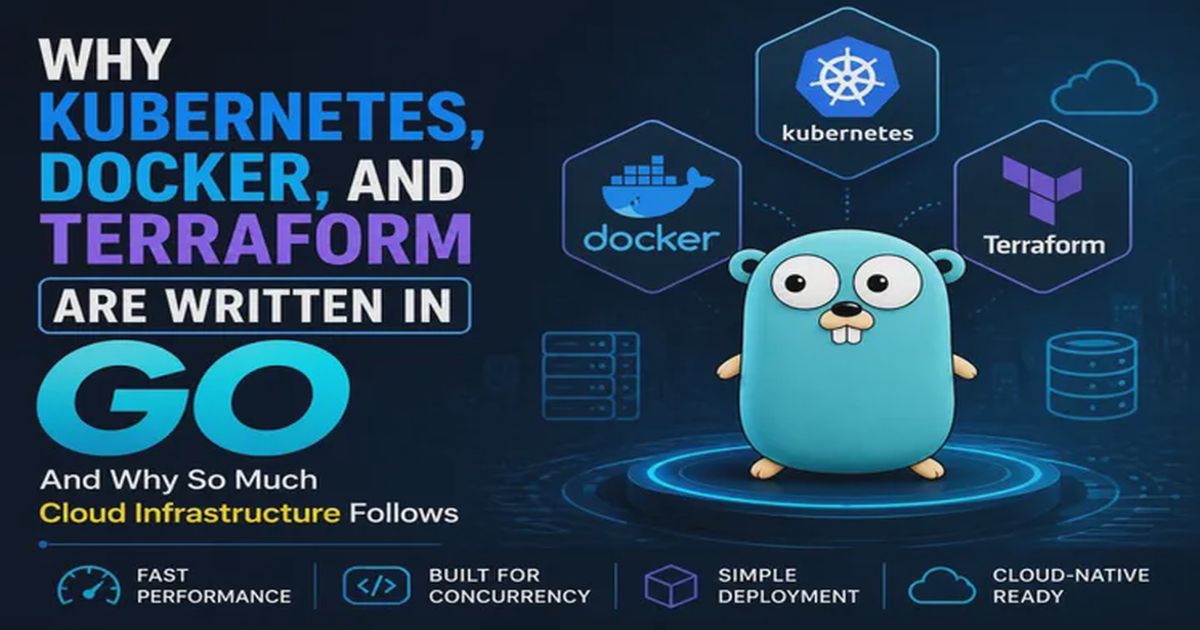
Open almost any major repository under the Cloud Native Computing Foundation (CNCF) umbrella, and you will encounter a codebase written in Go. From container runtimes like Docker and containerd, to orchestration systems like Kubernetes, service meshes like Istio, infrastructure automation tools like Terraform, and database systems like etcd—Go is the undisputed language of modern cloud infrastructure.
This convergence is remarkable. Before Go’s rise, the software engineering industry already possessed mature, powerful, and deeply entrenched languages. Java ruled the enterprise; Python dominated automation, scripting, and data science; C++ was the default for high-performance systems; and Rust was emerging with promises of memory safety and zero-cost abstractions. Yet, when the industry shifted to the cloud in the early 2010s, it chose a relatively new language created in 2009.
Was Go selected because it was the fastest? Not compared to C++ or Rust. Was it because it was the most feature-rich? Definitely not; Go’s syntax is famously minimal, lacking traditional object-oriented classes, inheritance, and, for its first decade, generics.
The explanation comes down to a unique mix of engineering constraints, runtime behavior, and developer economics. Go was built specifically to solve Google-scale software delivery challenges. When the rest of the industry transitioned from monolithic architectures to highly concurrent, distributed, cloud-native deployments, they found that Go’s design aligned perfectly with their new operational realities.
The Infrastructure Problem Most Developers Never Think About
Traditional business applications often follow a request-response model: a client makes a query, the application server queries a database, formats the result, and returns it. If the server runs out of memory or hits a thread bottleneck, we scale it horizontally behind a load balancer.
Infrastructure software operates under vastly different constraints. Systems like Kubernetes, Docker, or etcd are control planes and platform runtimes. They must run directly on physical or virtual hosts, interacting continuously with the operating system kernel, network stack, filesystem, and hardware.
Consider the requirements of a Kubernetes control plane. It must maintain a persistent, bidirectional connection to thousands of node agents (Kubelets), process a constant stream of API events, run reconciliation loops to align actual state with desired state, monitor cluster health, schedule containers, and configure virtual overlay networks. All of these operations happen concurrently, and failures in one component must not cascade to compromise the host operating system.
Similarly, a container engine like Docker must:
- Manipulate low-level Linux kernel primitives (namespaces, cgroups, chroot).
- Coordinate image layer synthesis on copy-on-write filesystems (OverlayFS, Btrfs).
- Create and destroy virtual network interfaces in real time.
- Manage high-volume daemon logs.
To support these workloads, infrastructure software requires:
- Low, Predictable Memory Footprint: Platform agents run on every single node. If an agent consumes 500MB of RAM, that memory cannot be allocated to user workloads. At scale across a cluster of 10,000 nodes, agent overhead translates directly into hundreds of thousands of dollars in wasted compute spend.
- Instantaneous Startup Times: In a cloud-native world, containers are ephemeral. If a node fails, the control plane must recover in milliseconds. If an autoscaling event triggers, new instances must boot instantly.
- High Networking Throughput: Modern infrastructure is a distributed web of microservices communicating via HTTP, gRPC, and Protocol Buffers. The language must support efficient, non-blocking I/O out of the box.
- Direct, Safe OS Access: Platform systems need to invoke kernel system calls (
syscall) without the complex translation layers, heavy runtime overhead, or memory-safety vulnerabilities of older languages.
Why Google Created Go
To understand why Go fits modern infrastructure, we have to look back to its inception at Google in 2007. The language was conceived by three legendary computer science pioneers: Rob Pike (co-designer of UTF-8 and member of the Plan 9 OS team), Ken Thompson (creator of B, co-creator of C, and co-inventor of Unix), and Robert Griesemer (who worked on JVM code generation and Chrome’s V8 engine) [1].
Google’s developers were struggling with the sheer scale of their software environment. They primarily wrote in C++ and Java, but these languages presented severe bottlenecks:
- Miserable Build Times: Compilation of massive C++ codebases took hours. The compiler spent significant time parsing header files repeatedly due to complex, nested dependency chains.
- Tangled Dependency Management: C++ lacked a unified package system, and circular dependencies frequently crept in, causing subtle runtime errors.
- Error-Prone Concurrency: Concurrent programming in C++ required manual thread management, complex lock systems, and careful tracking of memory allocation. Even simple multi-threaded tasks frequently led to data races, deadlocks, and memory corruption.
- Onboarding Friction: Large engineering teams needed a language where a developer of any skill level could read, understand, and maintain code written by anyone else in the organization.
The creators of Go wanted to build a language that rejected the growing complexity of C++. Instead of adding more features, they focused on simplicity and omission. Go was designed to combine the runtime efficiency of compiled languages like C++ with the developer productivity and ease of use of scripting languages like Python [2].
They established several foundational design decisions:
- No Class Inheritance: Go replaced object-oriented hierarchies with composition and implicit, structural interfaces.
- Statically Typed, Compiled Execution: Code compiles directly to native machine instructions, eliminating virtual machines or interpreters.
- Strict Dependency Rules: Go prohibits unused imports and circular dependencies at the compiler level, which results in lightning-fast compilation times.
- A Single Code Formatter: The introduction of the
gofmttool took styling choices out of the hands of developers, establishing a uniform visual style across all Go codebases globally.
The Feature That Changed Everything: Goroutines and the GMP Scheduler
If one technical feature cemented Go’s place in cloud computing, it is the goroutine.
In traditional systems programming, concurrency is mapped 1:1 to operating system (OS) threads. Creating an OS thread is expensive. It requires allocating a fixed stack memory block (typically 1MB to 8MB depending on the operating system), setting up thread registers, and performing context switches through kernel interrupts. An application running 10,000 OS threads will quickly exhaust its memory limits and spend more CPU time switching between threads than doing actual work.
Go bypassed this limitation by implementing an M:N scheduler directly inside its runtime. Instead of mapping one user thread to one OS thread, the Go runtime schedules M goroutines across N OS threads.
The GMP Scheduler Model
The Go scheduler is built around three structural entities:
- G (Goroutine): Represents a goroutine. It contains the execution stack, program counter, and internal flags. A goroutine starts with a minimal stack of only 2KB, which grows and shrinks dynamically in the heap as the call stack demands.
- M (Machine): Represents a physical OS thread managed by the OS kernel. To execute Go code, an OS thread (M) must be paired with a logical processor context (P).
- P (Processor): Represents a logical processor or execution resource. The number of P instances is determined by the
GOMAXPROCSenvironment variable (typically matching the host’s physical CPU cores). Each P maintains a local run queue of runnable goroutines (G).
       [Global Run Queue]
               │
               ▼ (fallback)
         ┌───────────┐
         │     P     │ ◄─── Work Stealing (steals from another P)
         └─────┬─────┘
               │ (manages local queue)
               ▼
     ┌───┐   ┌───┐   ┌───┐
     │ G │   │ G │   │ G │  (Local Run Queue)
     └───┘   └───┘   └───┘
               │
               ▼ (scheduled on)
         ┌───────────┐
         │     M     │  (OS Thread)
         └─────┬─────┘
               │
               ▼
         [Physical CPU]
Advanced Scheduler Primitives
To handle high volumes of parallel, blocking tasks without bottlenecking, the Go scheduler implements several sophisticated runtime behaviors:
- Work Stealing: If a logical processor P runs out of runnable goroutines in its local queue, it does not idle. It implements a work-stealing algorithm, attempting to steal half the runnable goroutines from the local run queue of another processor P. If all local queues are empty, it checks the global run queue, followed by the network poller.
- Syscall Preemption and Thread Handoff: When a goroutine (G) executes a blocking system call (e.g., read/write file systems, DNS queries), Go detaches the OS thread (M) carrying that goroutine from its logical processor (P). The P is then handed off to a new or idle OS thread (M’) to continue executing other runnable goroutines. Once the blocking system call returns, the original M tries to acquire an idle P to resume the goroutine; if none are available, it parks itself and puts the goroutine back on the global run queue.
- The Network Poller (Netpoller): Go integrates non-blocking network I/O natively. When a goroutine makes a network connection, Go uses the kernel’s event multiplexing API (
epollon Linux,kqueueon macOS,IOCPon Windows) through the internal netpoller. If a network operation blocks, the goroutine is detached from P and registered directly with the netpoller. The thread M continues running other goroutines. When the kernel signals that the network socket is ready, the netpoller wakes the parked goroutine, and it is placed back into the run queue of an available P.
For developers, network programming in Go looks synchronous and straightforward:
// This looks blocking, but under the hood, the Go runtime parks
// the goroutine in the netpoller and frees the OS thread for other work.
conn, err := net.Dial("tcp", "10.0.0.1:8080")
This architecture allows a single Go program to process millions of concurrent network connections using only a handful of OS threads, consuming a fraction of the memory that a thread-per-connection server would require.
Why Kubernetes Chose Go
In 2013, Google engineers Joe Beda, Brendan Burns, and Craig McLuckie began designing a successor to Borg—Google’s internal cluster orchestrator. Borg was written in C++, which delivered extreme performance but suffered from high compilation times, complex dependency configuration, and a steep developer learning curve.
The team initially experimented with several languages, including Java and Python. Brendan Burns even wrote the first prototype of Kubernetes in Java. However, the team quickly dropped the Java version and rebuilt the orchestrator in Go [3].
                  Google Borg (C++)
                          │
                          ▼
            [Initial Prototypes: Java/Python]
                          │
                          ▼ (re-architected for efficiency)
                 Kubernetes (Go)
Several engineering factors drove this decision:
1. The Cost of JVM Overhead at the Edge
Kubernetes is not just a centralized control plane; it requires an agent daemon (the kubelet) to run on every node in the cluster. If the kubelet had been built in Java, every node would require a running JVM instance, consuming hundreds of megabytes of system memory as baseline overhead. In 2014, when host sizes were smaller, running a JVM on every worker node meant sacrificing substantial capacity that could otherwise run applications. Go’s minimal runtime footprint allowed the kubelet to run with negligible memory overhead.
2. The Reconciliation Loop Pattern
Kubernetes operates on a declarative configuration model. Instead of issuing sequential commands, users submit a “desired state” (e.g., “maintain 3 replicas of this container”). The orchestrator runs continuous control loops—called reconciliation loops—that query the current state of the system, compare it to the desired state, and execute changes to reconcile the difference.
     ┌─────────────────────────────────────────┐
     │                                         │
     ▼                                         │
[Get Desired State] ──► [Get Current State] ───┴──► [Compare & Reconcile]
These loops execute continuously across dozens of controllers. Go’s first-class concurrency model—specifically channels, waitgroups, and select statements—made it simple to coordinate these concurrent loop mechanisms without complex thread locking.
3. Structural Typing and Interfaces
Kubernetes was designed from the beginning to be highly modular, abstracting container engines, storage volumes, and network providers. Go’s structural typing (interfaces implemented implicitly rather than explicitly declared) allowed Kubernetes engineers to define clear abstraction boundaries.
For example, the Container Runtime Interface (CRI) defines how Kubernetes interacts with runtimes like Docker, containerd, or CRI-O. Because Go does not require classes to explicitly declare they implement an interface, developers could build alternative runtimes independently without needing to import deep, tightly coupled class hierarchies.
Why Docker Chose Go
In late 2012, Solomon Hykes, founder of dotCloud, set out to democratize container virtualization. The Linux kernel had long supported isolation primitives, but they were notoriously difficult to configure.
Hykes’ original prototype of Docker was a Python application that wrapped shell commands. While Python was excellent for rapid prototyping, it faced significant limitations in production:
- It required the target host to have a specific Python interpreter and external dependencies installed.
- Executing shell commands through subprocesses introduced significant fork overhead and security vulnerabilities.
- Direct integration with low-level kernel system calls was slow and required complex foreign-function interfaces (FFIs).
In early 2013, the team chose to rewrite Docker entirely in Go [4].
[Docker Python Prototype] ──► (forked shell processes) ──► [Linux Kernel API]
                                    │
                                    ▼ (rewritten in Go)
[Docker Daemon (Go)] ──────────► (raw syscalls) ────────► [Linux Kernel API]
Go solved Docker’s low-level systems programming needs in three ways:
1. Direct Kernel Interfacing via the syscall Package
Go provides low-level systems access via its standard syscall package and the golang.org/x/sys/unix library. To launch a container, Docker must call Linux kernel APIs directly:
CLONE_NEWPIDto isolate process IDs.CLONE_NEWNETto isolate network interfaces.CLONE_NEWNSto mount isolated file systems.
Go allows developers to invoke these complex kernel syscalls directly without needing C/C++ wrappers or heavy performance translation layers. For instance, creating namespaces in Go is as straightforward as configuring a SysProcAttr struct:
cmd := exec.Command("/bin/sh")
cmd.SysProcAttr = &syscall.SysProcAttr{
    Cloneflags: syscall.CLONE_NEWUNSHARE |
                syscall.CLONE_NEWPID |
                syscall.CLONE_NEWNET |
                syscall.CLONE_NEWNS,
}
cmd.Run()
2. Eliminating Python Runtime Dependency
Docker was meant to run on any Linux host. By using Go, the Docker team could compile their system daemon (dockerd) and command-line interface (docker) into a single, dependency-free binary. A user could run Docker on a bare-metal machine, a virtual machine, or an embedded system simply by downloading the compiled executable.
Why Terraform Chose Go
HashiCorp’s Terraform revolutionized infrastructure-as-code by allowing developers to define public cloud, private cloud, and SaaS resources in declarative configuration files.
Two technical aspects of Go made it the natural choice for Terraform’s engine:
1. Parallel Directed Acyclic Graph (DAG) Traversal
Terraform reads configuration files, builds an internal dependency graph of resources (e.g., a subnet must exist before a virtual machine can be attached), and walks the graph to provision the infrastructure.
If resources do not share a dependency path (for instance, provisioning database servers in two separate regions), Terraform creates them in parallel to minimize deployment times.
          [VPC Network]
         /             \
        ▼               ▼
   [Subnet A]       [Subnet B]
        │               │
        ▼               ▼
   [Server A]       [Server B]
        \               /
         ▼             ▼
       [Load Balancer Instance]
Managing concurrent executions across a dynamically generated graph is historically complex. Go’s concurrency model—using channels to pass state and coordination signals, and sync.WaitGroup to join parallel execution threads—allowed HashiCorp engineers to construct a highly reliable, concurrent graph execution engine.
2. A Decentralized Plugin Architecture via RPC
Terraform supports thousands of cloud and service providers (AWS, Google Cloud, Azure, GitHub, Cloudflare, etc.). Bundling every provider codebase into the main Terraform binary would make the executable impossibly large and force HashiCorp to release a new version of Terraform every time a cloud provider added a single API parameter.
To decouple the core engine from provider code, HashiCorp developed go-plugin. In this architecture:
- Terraform Core and the individual Provider Plugins run as entirely separate operating system processes.
- When a user runs
terraform apply, Terraform Core launches the provider binaries as subprocesses. - The processes communicate locally over IPC (stdin/stdout or local TCP sockets) using gRPC and Protocol Buffers.
┌───────────────────────────┐
│   Terraform Core (Go)     │
└─────────────┬─────────────┘
              │
              ├───────► (gRPC over stdin/stdout) ───────► [AWS Provider (Go)]
              │
              └───────► (gRPC over stdin/stdout) ───────► [GCP Provider (Go)]
Go’s standard library support for OS process management, combined with its excellent networking libraries, made this multi-process plugin architecture performant, cross-platform, and stable.
The Power of Single Binary Deployment
One of Go’s most valuable advantages is static compilation. In Go, the compiler bundles the application code, the runtime scheduler, the garbage collector, and all imported packages into a single, self-contained machine-code binary.
We can enforce a completely static build—disabling runtime dependencies on dynamic system libraries like glibc—by setting the CGO_ENABLED flag to 0:
CGO_ENABLED=0 GOOS=linux GOARCH=amd64 go build -ldflags "-extldflags -static" -o myapp .
This compilation model offers massive benefits to cloud-native systems:
1. Dependency-Free Distributions
Dynamic linking requires the host operating system to supply runtime dependencies. For example, a dynamically linked C++ program might run on Ubuntu but crash on Alpine Linux due to differences in standard library implementations (glibc vs. musl). A statically compiled Go binary contains everything it needs to execute. It is completely portable across distributions.
2. Minimized Container Attack Surface
In modern cloud security, the safest container is the smallest container. Because a statically compiled Go binary runs independently of dynamic libraries, we can deploy Go applications using the scratch base image—a completely empty container base containing zero files, zero shell utilities, and zero package managers.
Compare a standard deployment to a scratch Go deployment:
# Dynamic Deploy (Node.js/Python/Java)
FROM ubuntu:22.04
RUN apt-get update && apt-get install -y ca-certificates curl
COPY . /app
WORKDIR /app
CMD ["node", "server.js"]
# Resulting Image Size: 250MB+
# Attack Surface: Shells, apt, curl, libc vulnerabilities

# Static Deploy (Go)
FROM scratch
COPY --from=builder /etc/ssl/certs/ca-certificates.crt /etc/ssl/certs/
COPY myapp /myapp
ENTRYPOINT ["/myapp"]
# Resulting Image Size: 15-30MB
# Attack Surface: Near-zero (no shell, no libraries to exploit)
If an attacker identifies a vulnerability in a Go application running inside a scratch container, they cannot run shell scripts, fetch external tools (no curl or wget), or execute typical privilege-escalation scripts.
Language Comparisons: Trade-offs in Infrastructure
No programming language is perfect. Choosing Go means accepting specific engineering trade-offs. To understand why Go dominated infrastructure, we must compare it to the alternatives across specific runtime and development vectors.
Go vs. Python
Python is one of the world’s most popular languages, widely used in script automation, AI/ML, and web development.
| Vector | Go | Python |
|---|---|---|
| Execution | Statically compiled to native machine instructions. | Interpreted bytecode via a runtime interpreter. |
| Concurrency | Low-overhead goroutines running across multiple CPU cores. | Bound by the Global Interpreter Lock (GIL); threads cannot run in parallel on multi-core systems. |
| Type System | Strict compile-time static typing. | Run-time dynamic typing. |
| Deployment | Single static executable. | Requires target python environment, packages (pip), and matching system libraries. |
The Verdict: While Python is excellent for single-purpose scripts and data science, its lack of true multi-core CPU parallelism (due to the GIL) and dynamic typing make it unsuited for complex distributed control planes like Kubernetes.
Go vs. Java
Java is the cornerstone of enterprise backend applications, possessing a massive ecosystem and sophisticated compilers.
| Vector | Go | Java |
|---|---|---|
| Runtime Model | Lightweight runtime compiled directly into the binary. | Executed inside a Java Virtual Machine (JVM). |
| Startup / Latency | Instantaneous boot times (milliseconds). | JVM cold-start latency; requires JIT compilation warmup. |
| Memory Footprint | Low footprint (~10-30MB baseline). | High memory footprint (~100-300MB baseline for JVM). |
| Concurrency | Built-in M:N scheduler (goroutines). | Platform threads mapped 1:1 to OS threads (Virtual Threads in Project Loom are newer and still integrating). |
| Garbage Collection | Optimized for low-latency concurrent pauses (<1ms). | Optimized for throughput; highly tunable but prone to stop-the-world pauses. |
The Verdict: The JVM provides excellent peak throughput but requires significant memory and startup warmup time. This makes Java ill-suited for edge agents (like kubelet), command-line utilities (like terraform or docker), and serverless endpoints where cold starts matter.
Go vs. Rust
Rust is Go’s primary modern competitor for systems programming, prioritizing safety, speed, and zero-cost abstractions.
| Vector | Go | Rust |
|---|---|---|
| Memory Management | Automatic garbage collection (runtime tri-color collector). | No garbage collector; compile-time borrow checker and ownership. |
| Developer Velocity | High. Simple syntax, fast compilation, low onboarding curve. | Moderate to Low. High cognitive load due to explicit memory lifetimes. |
| Compilation Speed | Fast. Designed for rapid compile loops. | Slow. Compiler runs extensive optimizations and safety checks. |
| Tail Latency | Predictable, but susceptible to minor GC sweeps. | Extremely predictable. Zero GC guarantees no garbage-collection pauses. |
The Verdict: Rust is technically superior when writing low-level data planes, service mesh proxies (like Linkerd or Envoy), and kernel components where garbage collection pauses cannot be tolerated. However, for control planes (like Kubernetes or Terraform) where extreme velocity, rapid compilation, and developer onboarding are more valuable than microsecond latency, Go’s simplicity wins.
The Ecosystem Flywheel Effect
Technical choices don’t happen in a vacuum. Once early cloud pioneers like Docker and Kubernetes adopted Go, it generated a powerful network effect—a developer flywheel.
    Kubernetes & Docker Choose Go
                  │
                  ▼
   CNCF Ecosystem Adopts Go Libraries
                  │
                  ▼
   Platform Developers Learn Go
                  │
                  ▼
   New Cloud Tools Built in Go (Prometheus, Istio, Helm)
                  │
                  └─────────── (cycles back to start)
Because Kubernetes was written in Go, its client libraries (client-go, apimachinery) were first-class citizens in the Go ecosystem. If an engineer wanted to build a custom Kubernetes operator, a monitoring agent (like Prometheus), a service mesh helper, or a deployment system (like Helm), writing it in Go allowed them to directly import Kubernetes packages without translation layers.
This created a self-reinforcing cycle. The CNCF became an ecosystem built by Go developers, for Go developers. Companies building cloud-native tools chose Go to integrate seamlessly with this ecosystem, making it the default language for platform engineering.
How to Choose: Which Language Fits Your Requirements?
Selecting a language for cloud infrastructure is not about declaring a single universal winner. Instead, it is about evaluating project constraints and selecting the language whose strengths align with the project’s core requirements.
The Requirements Scorecard
The matrix below maps Go, Rust, Python, and Java against key requirements of cloud-native development:
| Technical Requirement | Go | Rust | Python | Java |
|---|---|---|---|---|
| Sub-millisecond Tail Latency (No GC) | ⚠️ Moderate (Subject to GC jitter) | Excellent (Deterministic memory) | ❌ Poor (Runtime execution) | ⚠️ Variable (Requires tuning) |
| Low-Overhead High Concurrency | Excellent (Goroutines & GMP) | Excellent (Asynchronous syntax) | ❌ Poor (GIL bottleneck) | ⚠️ Moderate (Heavy OS threads) |
| Rapid Developer Onboarding | Excellent (Boring & readable syntax) | ⚠️ Difficult (Borrow checker learning curve) | Excellent (Highly accessible) | ⚠️ Moderate (Large language surface) |
| Operational Simplicity (Static builds) | Excellent (Single dependency-free binary) | Excellent (Single dependency-free binary) | ❌ Poor (Requires system packages) | ❌ Poor (Requires JVM/JAR libraries) |
| Direct OS/Kernel Interfacing | Excellent (First-class syscall support) |
Excellent (First-class native FFI) | ❌ Poor (Relies on system commands) | ❌ Poor (Requires JNI translation) |
The Architectural Decision Flow
To determine which language is the best fit for your infrastructure requirements, follow this decision tree:
Do you require direct OS system calls, native compilation, or high concurrency?
 ├── No (Simple setup scripts, automation, glue code) ──────► Choose PYTHON
 └── Yes (Platform agents, networks, databases)
      │
      └── Does your system run as a Data-Plane Proxy (handling packet/request routing)?
           ├── Yes ──► Do you have strict sub-millisecond tail-latency limits?
           │            ├── Yes (Envoy, Linkerd) ──────────────► Choose RUST
           │            └── No (High-performance API gateway) ──► Choose GO
           │
           └── No (Control plane, CLI tool, cluster coordinator)
                │
                └── What is your primary engineering constraint?
                     ├── Developer velocity & fast team scaling ──► Choose GO
                     ├── Minimal node memory footprint (<5MB) ────► Choose RUST
                     └── Legacy middleware & enterprise APIs ──────► Choose JAVA
Developer Economics: The Secondary Decision Vector
If your technical requirements point equally to Go and Rust, the final tiebreaker comes down to developer economics. Go was designed by Google specifically to solve the problems of software engineering at scale—where teams are large, developers have varying levels of experience, and code readability is paramount. Standardizing on Go minimizes the risk of maintenance bottlenecks because the code is structured, uniform, and readable by anyone on the team [5].
Getting Started with Go
Setting up a Go development environment is fast and straightforward. Go is designed to be cross-platform, with official support for Linux, macOS, and Windows.
1. Installation
- macOS (via Homebrew): Run
brew install go. - Linux (via APT on Ubuntu/Debian): Run
sudo apt update && sudo apt install golang-go. - Manual Installation: Download the pre-compiled installer package for your operating system directly from the official Go Downloads page.
After installation, verify that the compiler is correctly configured in your system path by checking its version:
go version
2. Creating Your First Module
Go uses a built-in package management system called modules. To initialize a new project, create a directory and run go mod init with your module path:
mkdir hello-cloud
cd hello-cloud
go mod init example/hello-cloud
This command creates a go.mod file, which tracks your dependencies and Go version.
3. Writing and Running a Simple Program
Create a file named main.go and add the following code:
package main

import "fmt"

func main() {
    fmt.Println("Hello, Cloud-Native World!")
}
To run this file directly without compiling it to disk, use the go run command:
go run main.go
# Output: Hello, Cloud-Native World!
To compile your code into a standalone, statically linked executable binary:
go build main.go
./main
Frequently Asked Questions (FAQ)
1. Why does Go use a garbage collector if it is a systems language?
Go was designed to prevent the memory leaks and pointer vulnerabilities that plague manual memory-managed languages like C and C++. A garbage collector ensures memory safety. Go’s runtime minimizes GC latency by using a concurrent, tri-color mark-and-sweep collector that runs concurrently with application threads, keeping pauses under 1 millisecond.
2. How does Go handle circular dependencies, and why does this affect compile speed?
Go prohibits circular dependencies at the compiler level. If package A imports package B, and package B imports package A, the compiler throws an error. This restriction forces developers to build clean, modular dependency graphs. It also enables the compiler to compile packages in parallel without parsing the same files multiple times, contributing to Go’s fast build times.
3. Can Rust replace Go in cloud-native infrastructure?
Rust is replacing Go in specific infrastructure niches, particularly high-performance data planes, proxies, and container runtimes (e.g., Firecracker, Linkerd, and WebAssembly engines). However, for control planes, API services, and infrastructure-as-code tools, Go’s high developer velocity and lower learning curve make it unlikely that Rust will replace it entirely.
4. What is the impact of the GOMAXPROCS environment variable?
GOMAXPROCS defines the number of logical processors (P) available to run Go code. By default, the Go runtime sets this to the number of physical CPU cores on the host machine. In containerized environments (like Docker or Kubernetes limits), Go historically read the host’s CPU count rather than the container’s limits. This could cause the runtime to spawn too many threads, leading to throttling. Modern deployments use libraries like Uber’s automaxprocs to automatically configure this variable according to container limits.
5. How does Go’s runtime handle preemptive scheduling?
Before Go 1.14, Go’s scheduler was cooperatively preemptive, meaning a goroutine could only be preempted if it made a function call (allowing the scheduler to run stack checks). If a goroutine ran a tight, loop-bound CPU calculation without function calls, it could hog the OS thread and block other goroutines. In Go 1.14+, the runtime introduced asynchronous preemption using OS signals (e.g., SIGURG), allowing the scheduler to safely interrupt and preempt long-running loops [6].
6. What is the latest stable version of Go?
As of mid-2026, the latest stable major release of Go is Go 1.26 (specifically patch version Go 1.26.4, released on June 2, 2026). The Go team maintains a predictable release schedule, delivering new major versions twice a year (typically in February and August) alongside regular patch updates for stability and security.
Final Thoughts
Go’s success highlights the power of pragmatic design in software engineering. Go didn’t take over the cloud because it had the most advanced type system or the absolute fastest execution times. It won because it solved the operational, architectural, and organizational challenges of modern computing.
By providing lightweight concurrency through goroutines, simple deployment via static binaries, direct system-level access, and a design optimized for readability and maintainability, Go gave engineers the exact tools they needed to construct the modern cloud-native stack.
More than a decade after its release, that pragmatic foundation continues to support the global cloud infrastructure. When you look beneath the hood of the modern cloud, you’ll almost always find Go.
References
- [1] Griesemer, R., Pike, R., & Thompson, K. (2009). Design of the Go Programming Language (FAQ). Google Engineering Publications.
- [2] Pike, R. (2012). Go at Google: Language Design in the Service of Software Engineering. Google Technical Report.
- [3] Burns, B. (2019). Designing Distributed Systems: Patterns and Paradigms for Scalable, Reliable Services. O’Reilly Media.
- [4] Hykes, S. (2013). Why Docker chose Go for its system daemon rewrite. Docker Blog Archive.
- [5] Pike, R. (2012). Go: Less is exponentially more. blogspot.com.
- [6] Go Development Team. (2020). Go 1.14 Release Notes: Asynchronous Preemption of Goroutines. Go Project Documentation.
Want to deploy apps, clusters, or customize hosting services?
Explore our services at siliconpin.com or learn more about our specialized Go hosting to start building your own edge infrastructure today.
Subhodip Ghosh
Engineering, systems programming, and curated technology insights.