Why Linus Torvalds Gets Angry When People Say “99% of Code Is Written by AI”
Linux creator Linus Torvalds explains why AI can improve developer productivity but still cannot replace human understanding, software architecture, and engineering expertise.
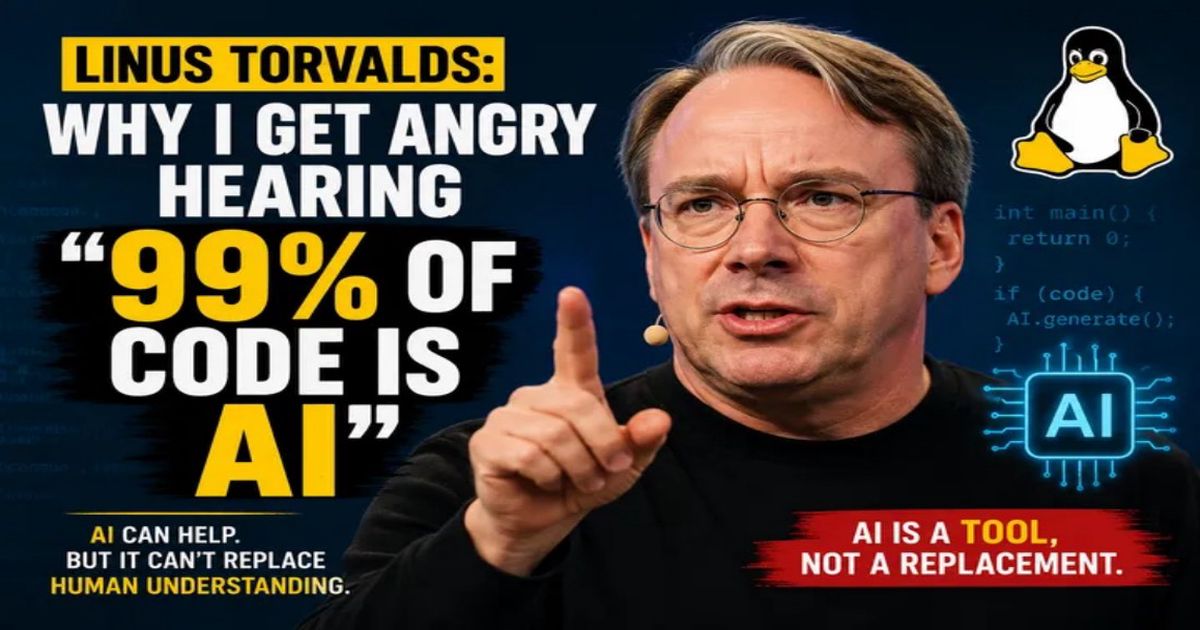
Linux creator Linus Torvalds explains why AI can improve developer productivity but still cannot replace human understanding, software architecture, and engineering expertise.
Artificial Intelligence is transforming software development faster than ever before. Tools like ChatGPT, Claude, GitHub Copilot, and Cursor can generate code in seconds, automate repetitive tasks, and help developers work more efficiently.
As these tools become increasingly capable, bold claims have started appearing across social media and tech communities. Some people even argue that AI now writes most of the code in modern software projects.
However, Linux creator Linus Torvalds believes these claims are greatly exaggerated.
During a keynote discussion at the Open Source Summit, Torvalds pushed back against the growing narrative that AI is responsible for the majority of software development. While he acknowledged the benefits of AI-powered coding tools, he emphasized that software engineering involves much more than generating lines of code.
So why does Linus Torvalds get frustrated when he hears statements like “99% of code is written by AI”? Let’s explore his perspective and what it means for the future of programming.
The Problem With the “99% of Code Is AI” Narrative
According to Torvalds, many discussions about AI focus too heavily on code generation while ignoring the broader responsibilities of software engineers.
Writing code is only one part of the software development process.
Professional developers spend a significant amount of time:
-
Understanding complex systems
-
Designing software architecture
-
Reviewing and testing code
-
Fixing bugs
-
Optimizing performance
-
Maintaining large codebases
-
Ensuring security and reliability
AI can assist with many of these tasks, but it does not truly understand the software it generates.
This is where Torvalds believes many AI-related claims become misleading.
A model may generate hundreds of lines of code within seconds, but someone still needs to verify that the code works correctly, integrates properly with existing systems, and remains maintainable in the long term.
AI Is a Powerful Tool, Not a Replacement
One of Torvalds’ most important points is that AI should be viewed as a tool rather than a replacement for developers.
Throughout computing history, developers have continuously adopted tools that improve productivity.
Examples include:
-
Compilers
-
Debuggers
-
IDEs
-
Version control systems
-
Automated testing frameworks
AI is simply the latest addition to this list.
Just as compilers eliminated the need to manually write machine code, AI can reduce the amount of repetitive coding developers need to perform.
However, using a tool effectively still requires knowledge and expertise.
A compiler cannot decide how a software system should be designed.
Similarly, AI cannot fully understand business requirements, system constraints, user needs, or long-term maintenance challenges.
The responsibility remains with the engineer.
Why Human Understanding Still Matters
One reason Torvalds remains cautious about AI hype is that software development is fundamentally about understanding.
Consider a large project such as the Linux kernel.
The Linux kernel contains millions of lines of code contributed by thousands of developers over several decades.
Maintaining such a system requires:
-
Deep technical knowledge
-
Understanding of hardware interactions
-
Performance optimization expertise
-
Security awareness
-
Long-term architectural planning
Generating code snippets is relatively easy.
Understanding how those snippets affect an entire operating system is significantly harder.
This distinction is what many AI enthusiasts overlook.
AI can help create code.
Humans must understand why that code exists and whether it should exist in the first place.
The Growing Problem of AI-Generated Noise
Torvalds has also expressed concerns about the increasing volume of AI-generated reports and contributions within open-source communities.
Many maintainers are seeing:
-
Low-quality bug reports
-
Duplicate issues
-
Incorrect vulnerability claims
-
Unverified AI-generated analysis
While AI can help identify potential problems, it can also produce large amounts of inaccurate information.
For open-source maintainers who already have limited time, reviewing these submissions creates additional work.
This highlights another challenge of AI-assisted development: quantity does not always equal quality.
Generating information is easy.
Validating information is difficult.
What Developers Should Learn From This
The message from Torvalds is not anti-AI.
In fact, he recognizes that AI can significantly improve productivity.
The real lesson is that developers should focus on skills that AI cannot easily replace.
These include:
1. System Design
Understanding how software components interact is more valuable than simply generating code.
2. Problem Solving
AI can suggest solutions, but developers must determine whether those solutions are correct.
3. Debugging
Finding and fixing complex issues remains one of the most important engineering skills.
4. Security Awareness
Developers must identify vulnerabilities and understand the risks associated with generated code.
5. Critical Thinking
Every AI-generated output should be reviewed and evaluated rather than accepted blindly.
The Future of AI and Software Development
AI will almost certainly become a standard part of the software development workflow.
Future coding assistants will become faster, smarter, and more capable.
They may:
-
Generate larger portions of applications
-
Automate testing
-
Assist with documentation
-
Improve debugging workflows
-
Accelerate development cycles
But even as AI evolves, software engineering will continue to require human judgment.
Businesses do not hire engineers simply to type code.
They hire engineers to solve problems.
And solving problems requires context, experience, creativity, and understanding—qualities that AI still struggles to replicate.
Final Thoughts
Linus Torvalds’ criticism of the “99% of code is written by AI” claim is not an attack on artificial intelligence.
Instead, it is a reminder that software development is about much more than producing code.
AI can generate code.
AI can improve productivity.
AI can accelerate workflows.
But understanding systems, designing architectures, making engineering decisions, and ensuring long-term reliability remain human responsibilities.
As AI continues to reshape the tech industry, the most successful developers will not be those who compete against AI.
They will be the ones who learn how to use AI effectively while strengthening the uniquely human skills that technology cannot easily replace.
In the end, AI may write more code than ever before, but developers will still be responsible for understanding what that code does—and why it matters.
Frequently Asked Questions
Did Linus Torvalds say AI is useless?
No. Torvalds has acknowledged that AI is a powerful productivity tool that can help developers work more efficiently.
Does Linus Torvalds think AI will replace programmers?
No. He believes AI can assist programmers but cannot replace human understanding, architecture design, debugging, and decision-making.
Why is the “99% of code is AI-generated” claim controversial?
Because generating code is only one part of software engineering. Building, maintaining, testing, securing, and understanding software still requires significant human involvement.
Should developers learn AI tools?
Yes. AI tools can improve productivity, but developers should also continue strengthening their problem-solving, debugging, and system design skills.
Subhodip Ghosh
Engineering, systems programming, and curated technology insights.