Raspberry Pi Lost Its Own Game? This Small SBC Is Changing Everything
Raspberry Pi once ruled the SBC world but things are changing. See how Orange Pi 5 Plus challenges it with more power, flexibility, and modern features.
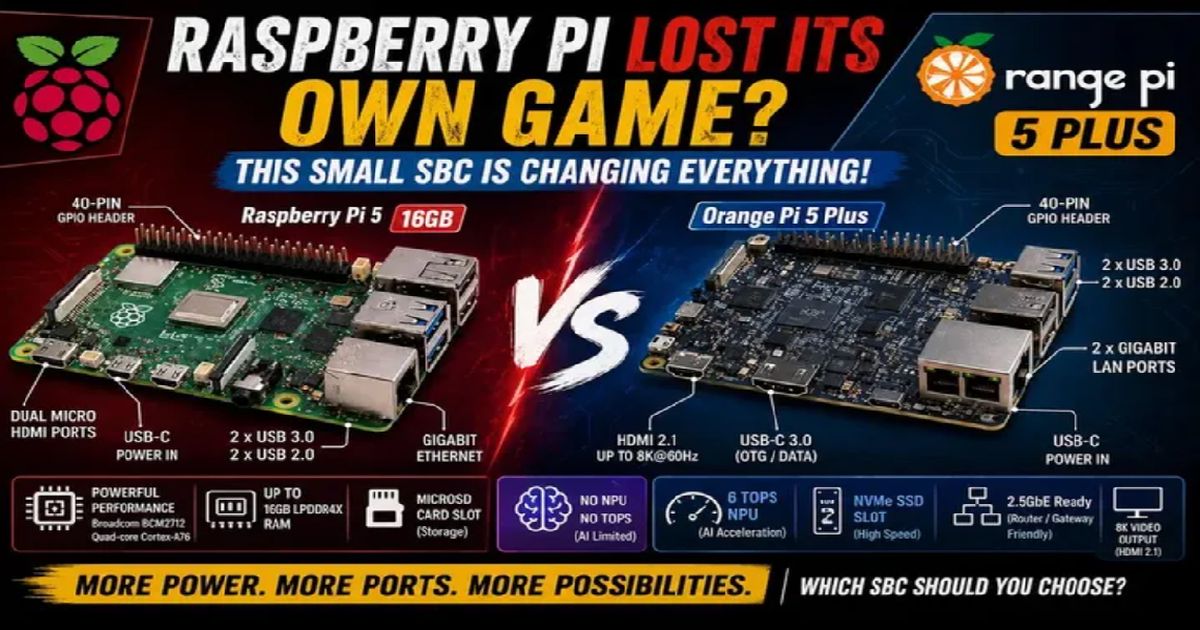
For years, the Raspberry Pi was the undisputed king of the single-board computer (SBC) world. Whether you were a student learning Linux, a developer building a prototype, or a hobbyist automating your home, Raspberry Pi was always the top recommendation
But something has changed.
Today, a new generation of SBCs is challenging that dominance. Devices like the Orange Pi 5 Plus are no longer just ‘alternatives’—in many cases, they outperform Raspberry Pi in raw power, flexibility, and modern features. flexibility, and modern features.
So, has Raspberry Pi really lost its edge? Or is the story more complicated than that?
Let’s break it down.
The Rise of Raspberry Pi: From Revolution to Reality
When Raspberry Pi was first introduced, its goal was simple:
👉 Make computing affordable and accessible to everyone.
And it worked.
- Ultra-low price
- Massive community support
- GPIO pins for hardware projects
- Simple Linux-based ecosystem
It became the backbone of:
- STEM education
- DIY electronics
- IoT projects
- Home labs
Fast forward to today, and we now have the Raspberry Pi 5 (16GB variant) — more powerful than ever, but also more expensive and harder to get.
What Changed? The Current State of Raspberry Pi
Despite its improvements, Raspberry Pi is facing some real challenges:
Price Drift
What started as a budget-friendly board is no longer “cheap” for many users.
Availability Issues
Post-pandemic supply chain problems made Raspberry Pi difficult to find consistently.
Hardware Limitations
Even with upgrades, it still lacks:
- Native NVMe support (without adapters)
- High-end AI acceleration
- Modern high-performance CPU architecture compared to competitors
Performance Ceiling
For modern workloads like AI, container orchestration, or media processing — it starts to struggle.
Orange Pi 5 Plus: The Powerful Challenger to Raspberry Pi
This is where things get interesting.
The Orange Pi 5 Plus is powered by the RK3588 chipset, and it’s not playing around.
Key Highlights:
- Octa-core CPU (ARM Cortex-A76 + A55)
- Up to 32GB RAM options
- Built-in NVMe SSD support
- 8K video output capability
- NPU (AI accelerator) with TOPS performance
What is TOPS?
TOPS (Tera Operations Per Second) measures AI processing power.
The higher the TOPS, the better the board can handle:
- Machine learning models
- Computer vision
- Edge AI workloads
👉 Orange Pi boards offer significantly higher TOPS compared to Raspberry Pi, which lacks a dedicated NPU.
GPIO Still Matters (And Raspberry Pi Still Leads the Way)
Let’s not ignore one important factor: GPIO (General Purpose Input/Output) pins.
Raspberry Pi:
- Mature GPIO ecosystem
- Extensive libraries (Python, C, etc.)
- Huge community support
Orange Pi:
- GPIO available, but:
- Less standardized
- Smaller community
- More manual configuration
👉 If your project depends heavily on hardware interfacing (sensors, robotics), Raspberry Pi is still more beginner-friendly.
Raspberry Pi 5 (16GB) vs Orange Pi 5 Plus: The Real Comparison
| Feature | Raspberry Pi 5 (16GB) | Orange Pi 5 Plus |
|---|---|---|
| CPU | Good | High-performance (RK3588) |
| RAM | Up to 16GB | Up to 32GB |
| Storage | microSD / USB | NVMe SSD (native) |
| GPU | Decent | 8K capable |
| AI (TOPS) | ❌ No NPU | ✅ Dedicated NPU |
| GPIO | Excellent | Moderate |
| Price-to-performance | Medium | High |
| Availability | Limited | Better |
👉 On paper, Orange Pi clearly wins in raw performance.
Can You Use the Orange Pi 5 Plus as a Router?
One underrated advantage of the Orange Pi 5 Plus:
👉 It comes with multiple LAN ports.
This opens up use cases like:
- DIY router (using OpenWRT or Linux)
- Network firewall
- Load balancer
- Edge gateway system
This is something Raspberry Pi simply doesn’t offer natively.
Orange Pi Now Offers the New Orange Pi 6 Plus
If the Orange Pi 5 Plus was already putting pressure on the Raspberry Pi ecosystem, the release of the Orange Pi 6 Plus makes one thing very clear — the SBC market is evolving fast, and Orange Pi is not waiting around.
Unlike previous generations, this board is designed with a strong focus on AI and high-performance edge computing.
What Makes Orange Pi 6 Plus Different?
-
Significantly Higher AI Performance (TOPS)
Built for AI workloads like computer vision, automation, and edge inference. -
Next-Gen CPU Architecture
More efficient and powerful compared to earlier SBC generations. -
Improved Power Efficiency
Better performance-per-watt, which is critical for always-on systems. -
Stronger Hardware Integration
Designed for modern workloads — not just hobby projects anymore.
Real-World Use Cases: Which SBC Performs Best?
🟢 Raspberry Pi is still best for:
- Beginners & students
- Educational projects
- Simple IoT setups
- GPIO-heavy hardware builds
🔵 Orange Pi (5 Plus / 6 Plus) is better for:
- AI & ML workloads
- Kubernetes (K3s clusters)
- Media servers (4K/8K streaming)
- DevOps testing environments
- Network systems (router/firewall)
Did Raspberry Pi Really Lose — Or Just Face Real Competition?
Not exactly.
Raspberry Pi didn’t lose — but it’s no longer alone at the top.
👉 It still dominates in:
- Community
- Documentation
- Ease of use
👉 But it’s being challenged in:
- Performance
- Innovation
- Modern workloads
And for developers, that’s actually a good thing.
Why This Matters (Especially for Developers)
We’re entering a world where SBCs are no longer just “mini computers” — they’re becoming:
- Edge computing nodes
- AI processing units
- Lightweight servers
👉 You can now:
- Run Kubernetes (K3s) on SBC clusters
- Deploy self-hosted apps
- Build low-cost cloud infrastructure
- Experiment with AI at the edge
And boards like Orange Pi are making that easier than ever.
Final Thoughts
Raspberry Pi started the revolution — no doubt about that.
But today, the competition is stronger, faster, and more ambitious.
👉 The real winner?
Developers like you.
Because now, you have choices.
And in tech, choice always drives innovation.
(FAQs) Frequently asked Questions
What is the best alternative to Raspberry Pi?
Orange Pi 5 Plus is currently one of the strongest alternatives due to its performance and features.
Does Raspberry Pi support AI workloads?
Not natively. It lacks a dedicated NPU, so AI workloads are limited.
What is TOPS in SBC?
TOPS measures AI processing capability (Tera Operations Per Second).
Can Orange Pi be used as a router?
Yes, especially models like Orange Pi 5 Plus with multiple LAN ports.
Want to deploy apps, clusters, or Customize hosting services?
👉 Explore our services at siliconpin.com and start building your own edge infrastructure today.
Subhodip Ghosh
Engineering, systems programming, and curated technology insights.