Resource Pooling, Pre-allocation, and Soft Memory Limits in GO programming language
memory management is primarily about optimizing allocations to reduce the workload of the Garbage Collector (GC)
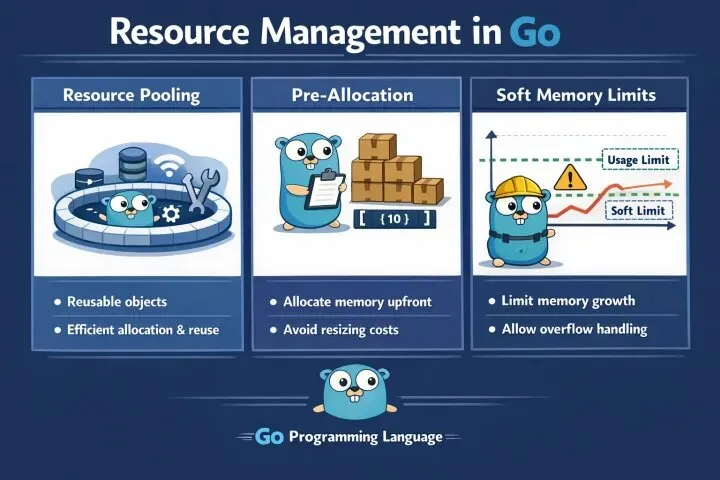
Go does not have a native malloc function for standard Go code, but you can still access malloc behavior in specific ways. Because Go is garbage-collected, the runtime uses its own internal allocator (originally based on TCMalloc) rather than the system’s malloc for standard allocations.
Here are the ways you can use or approximate malloc in Go:
1. Using malloc via Cgo
If you need manual memory management, you can call the C library’s malloc and free using Go’s cgo tool.
Manual Control: You must manually call C.free() for every C.malloc(). The Go garbage collector will not clean up this memory.
Usage: It is commonly used when interfacing with C libraries or for high-performance “off-heap” storage where you want to bypass the GC entirely.
C helper: C.CString and C.CBytes also use malloc internally and require manual freeing.
2. The Internal mallocgc
The Go runtime has a core allocation function called mallocgc, which is what built-in functions like new() and make() call under the hood.
Unexported: This function is not public and cannot be called directly in standard Go code.
Behavior: Unlike C’s malloc, which returns uninitialized memory, mallocgc usually returns zero-initialized memory and registers the object with the garbage collector.
3. Memory Arenas (Go 1.20+)
Go introduced an experimental arena package (often used via GOEXPERIMENT=arena) that provides a malloc-like experience for allocating blocks of memory.
Efficiency: It allows you to allocate many objects and free them all at once at the end of an operation, which is much faster than individual GC sweeps.
Caution: As of 2025, this feature is still considered experimental in some versions and should be used with care in production.
4. Alternatives to Manual Allocation
In most cases, you don’t need malloc because Go provides safer alternatives:
new(T): Allocates zeroed storage for a new item of type T and returns its address.
make(): Used specifically for slices, maps, and channels.
sync.Pool: Instead of manual allocation/deallocation, use the sync.Pool package to reuse objects and reduce GC pressure.
package main

import (
	"fmt"
	"runtime"
	"runtime/debug"
	"sync"
)

// 1. RESOURCE POOLING: Using sync.Pool to reuse objects (buffers)
// instead of constantly allocating/deallocating them on the heap.
var bufferPool = sync.Pool{
	New: func() any {
		// Allocates a fresh 1KB buffer only when the pool is empty
		return make([]byte, 1024)
	},
}

func main() {
	// 2. SOFT MEMORY LIMIT: Setting a target limit for the heap (e.g., 512MB).
	// This helps prevent OOM (Out Of Memory) crashes in container environments.
	debug.SetMemoryLimit(512 * 1024 * 1024)

	// 3. PRE-ALLOCATION: Avoiding re-allocations by specifying capacity upfront.
	// This prevents the slice from having to grow and copy data multiple times.
	data := make([]int, 0, 1000)
	for i := 0; i < 1000; i++ {
		data = append(data, i)
	}

	// Demonstration of sync.Pool usage
	for i := 0; i < 5; i++ {
		processWithPool()
	}

	// 4. MONITORING: Inspecting the current memory state.
	printMemStats()
}

func processWithPool() {
	// Acquire a buffer from the pool (might be reused)
	buf := bufferPool.Get().([]byte)

	// Ensure the buffer is returned to the pool for reuse after the function ends
	defer bufferPool.Put(buf)

	// Simulate work using the buffer
	copy(buf, []byte("Managing memory in 2025"))
}

func printMemStats() {
	var m runtime.MemStats
	runtime.ReadMemStats(&m)
	fmt.Printf("Allocated Heap: %v KB
", m.Alloc/1024)
	fmt.Printf("Total Allocations: %v
", m.TotalAlloc)
	fmt.Printf("GC Cycles: %v
", m.NumGC)
}
SUVANKAR SARKAR
Engineering, systems programming, and curated technology insights.